S&P500 Trading Update 5/5/26

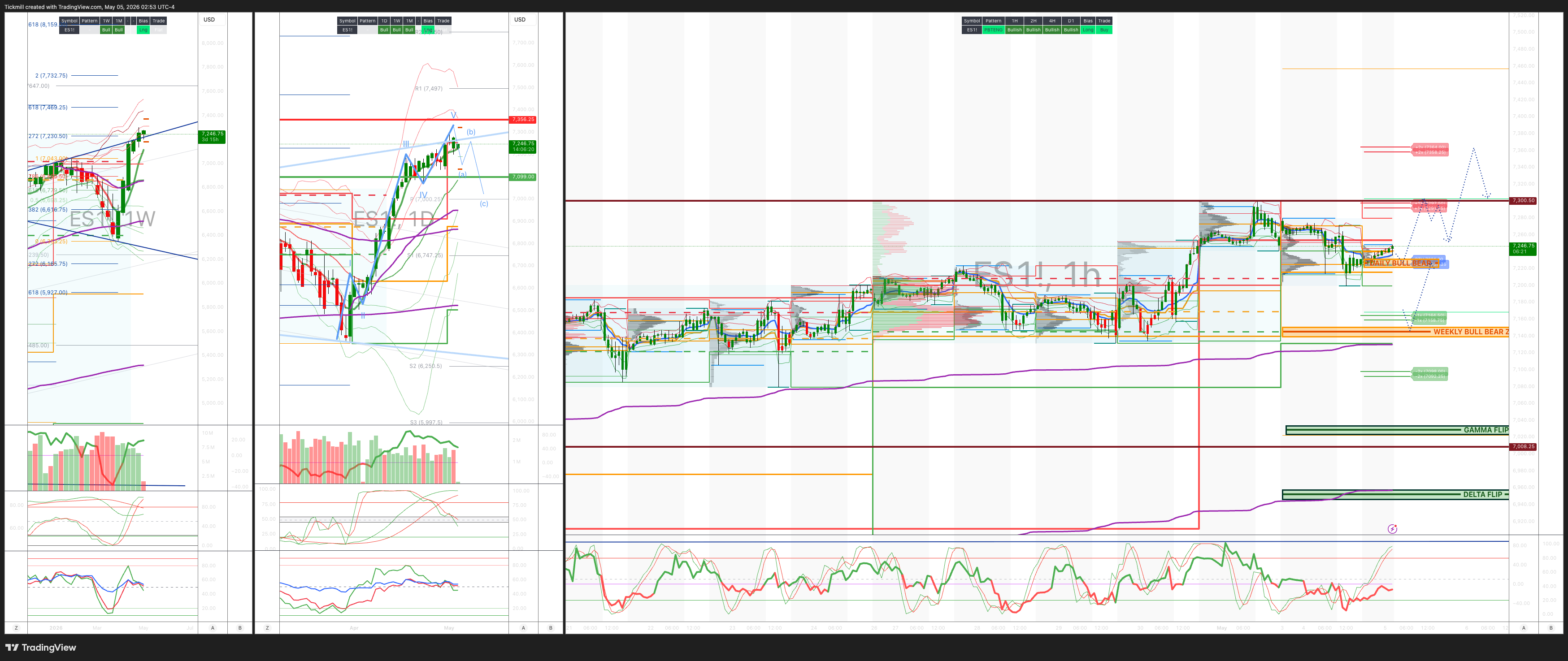
S&P500 Trading Update 5/5/26
***QUOTING ES1! FOR CASH US500 EQUIVALENT LEVELS, SUBTRACT POINT DIFFERENCE***
WEEKLY BULL BEAR ZONE 7150/40
WEEKLY RANGE RES 7356 SUP 7138
May OPEX Straddle: 225pt range implies a OPEX to OPEX range of [6900, 7350]
June QOPEX Straddle is 546.4pt giving us a range of [5960,7052]
JHEQX Q2 Collar 6189/6290 - 6865/6955
DEC2025 OPEX to DEC2026 OPEX is 945 points giving us a range of [5889,7779]
SPX PUT/CALL RATIO 1.29 (The numbers reflect options traded during the current session. A put-call ratio below 0.7 is generally considered bullish, and a put-call ratio above 1.0 is generally considered bearish)
DAILY VWAP BULLISH 7225
WEEKLY VWAP BULLISH 7118
MONTHLY VWAP BULLISH 6898
DAILY STRUCTURE – OTFH - 7157
WEEKLY STRUCTURE – OTFH - 7137
MONTHLY STRUCTURE - OTFH - 6514
Balance: This refers to a market condition where prices move within a defined range, reflecting uncertainty as participants await further market-generated information. Our approach to balance includes favouring fade trades at the range extremes (highs/lows) while preparing for potential breakout scenarios if the balance shifts.
One-Time Framing Higher (OTFH): This represents a market trend where each successive bar forms a higher low, signalling a strong and consistent upward movement.
One-Time Framing Down (OTFD): This describes a market trend where each successive bar forms a lower high, indicating a pronounced and steady downward movement.
DAILY BULL BEAR ZONE 7220/30
GAMMA FLIP 7025
DELTA FLIP 6950
DAILY RANGE RES 7296 SUP 7164
2 SIGMA RES 7356 SUP 7098
VIX BULL BEAR ZONE 19.5
TRADES & TARGETS
LONG ON ACCEPTANCE ABOVE DAILY BULL BEAR ZONE TARGET DAILY > WEEKLY RANGE RES
LONG ON REJECT/RECLAIM WEEKLY BB ZONE TARGET RTH CLOSE
***ADDITIONAL SETUPS & TARGETS HIGHLIGHTED ON THE CHARTS***
(I FADE TESTS OF 2 SIGMA LEVELS ESPECIALLY INTO THE FINAL HOUR OF THE NY CASH SESSION AS 90% OF THE TIME WHEN TESTED THE MARKET WILL CLOSE ABOVE OR BELOW THESE LEVELS)
GOLDMAN SACHS TRADING DESK VIEW - ‘Dispersion’
US equities started the week softer as higher oil and higher yields reasserted themselves as the macro ceiling for risk. S&P -41bps to 7,200, NDX -21bps to 27,651, R2K -60bps to 2,795, and Dow -113bps to 48,941, with a -$3.5bn MOC sell imbalance and light volumes of 16.4bn shares versus a 18.2bn YTD average. Cross-asset tone was less supportive: Brent +5% to $114, WTI +297bps to $104.97, 10Y +6bps to 4.43%, DXY +32bps to 98.46, while gold -264bps to $4,521 and VIX +765bps to 27.30. The message is straightforward: earnings and AI can still support the tape, but oil plus yields higher remains the toxic combination for duration, margins, consumers and Fed expectations.
Retail underperformed again, and the US cyclicals vs defensives pair fell ~125bps, its second-worst day in about a month, after failing to break to new highs. That argues for a more defensive posture: fade weak cyclicals and retail rallies, avoid chasing broad beta while Brent stays above $110 and the 10Y pushes back toward the mid-4s, and use strength to clean up crowded risk. Under the hood, tech dispersion remains the market.
Neoclouds extended gains, software showed better follow-through with some SMID charts starting to improve, and memory was strong — MU +6% — helped by Korea/Taiwan strength and positive pricing/DDR6 narratives. But the CPU/edge-compute complex was weak, with QCOM -5%, ARM -4%, AMD -5%, partly ahead of AMD’s print. The takeaway is to stop treating tech as one bucket: prefer software/memory winners and custom/AI infrastructure beneficiaries versus crowded or uncertain CPU/merchant-compute laggards. AMD now becomes the next key read-through for AI compute sentiment; a clean print can stabilize the group, while a messy one reinforces the rotation toward memory, software and custom silicon.
Flows did not show strong sponsorship: floor activity was only 3/10, the desk finished -8% for sale versus a 30-day average of +17bps, asset managers were flat, and HFs were slight net sellers across macro, discretionary and energy. This was not a high-conviction selloff, but neither was it a dip being aggressively bought. Post-close, PLTR +1% beat/raised with acceleration in US government but stable US commercial growth, PINS +17% delivered a clean beat and Q2 revenue guide above consensus, INSP -18% cut its revenue outlook to $825–875mn, implying a 4–10% decline versus 2025, and DUOL -15% traded lower on FY guidance slightly below expectations.
In derivatives, the important signal was that vol and skew both rose, with front-end skew heavily bid as clients added hedges across indices and monetized upside in single names. The desk sees owning downside as attractive here, especially because SPX 3m 25-delta puts versus average single-stock implied vol are trading at their largest discount on a 15-year lookback. That argues for buying index downside rather than paying up for single-name vol. Preferred expressions remain SPX/SPY put spreads or 3m 25-delta put structures, funded by taking profits on single-name upside after the earnings run. The rest-of-week straddle went out around 1.28%, with earnings, geopolitical headlines and NFP Friday still ahead, so be careful selling short-dated vol into this tape. Bottom line: this is not a panic tape, but it is no longer a clean melt-up. Higher oil, higher yields, weaker cyclicals, retail underperformance and rising skew argue for caution. Stay tactical, own cheap index protection, fade weak cyclicals/retail, monetise crowded single-name upside, and trade tech dispersion rather than broad beta.
Disclaimer: The material provided is for information purposes only and should not be considered as investment advice. The views, information, or opinions expressed in the text belong solely to the author, and not to the author’s employer, organization, committee or other group or individual or company.
Past performance is not indicative of future results.
High Risk Warning: CFDs are complex instruments and come with a high risk of losing money rapidly due to leverage. 68% and 74% of retail investor accounts lose money when trading CFDs with Tickmill UK Ltd and Tickmill Europe Ltd respectively. You should consider whether you understand how CFDs work and whether you can afford to take the high risk of losing your money.
Futures and Options: Trading futures and options on margin carries a high degree of risk and may result in losses exceeding your initial investment. These products are not suitable for all investors. Ensure you fully understand the risks and take appropriate care to manage your risk.
Patrick has been involved in the financial markets for well over a decade as a self-educated professional trader and money manager. Flitting between the roles of market commentator, analyst and mentor, Patrick has improved the technical skills and psychological stance of literally hundreds of traders – coaching them to become savvy market operators!