Institutional Insights: Standard Chartered Weekly Market View


Cross-Asset Strategy — Equities Break Out, but Don’t Re-Concentrate the Portfolio
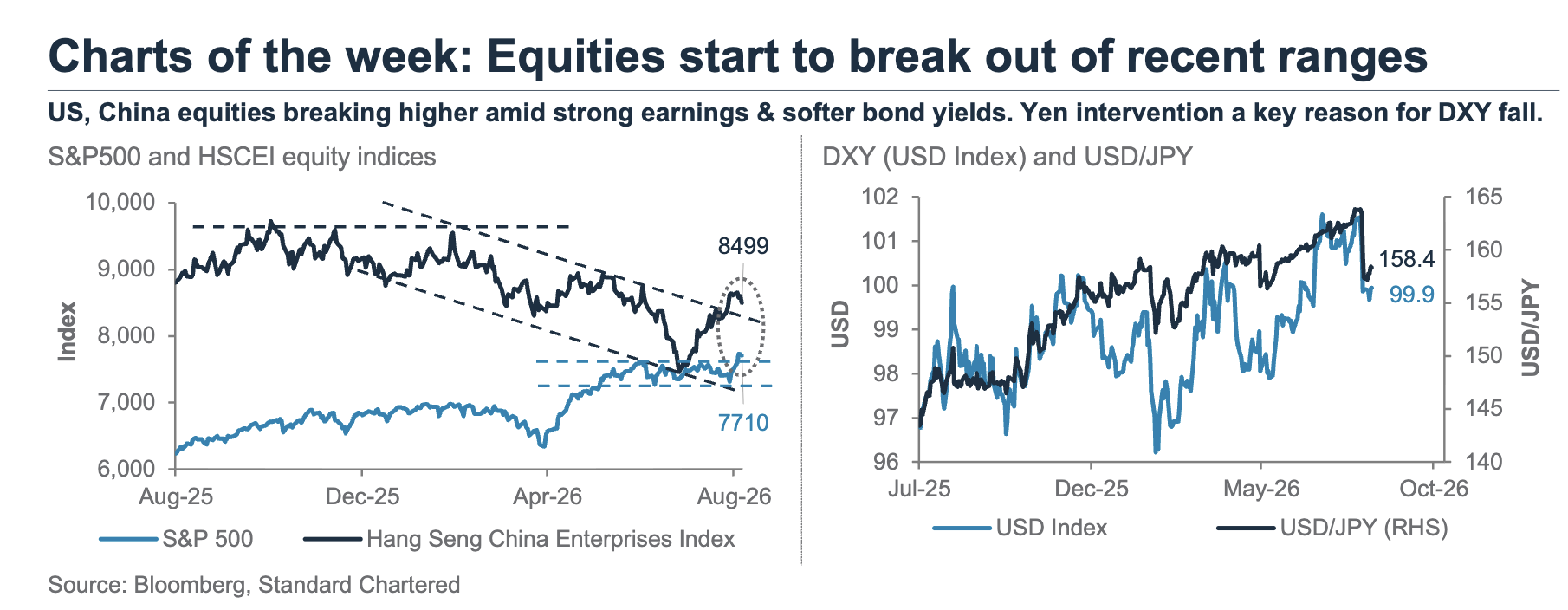
The strategy note is constructively risk-on: major equity indices have broken out of recent ranges, supported by strong earnings, softening US real yields, and reduced oil-tail risk after the Oman-Iran Strait of Hormuz reopening headlines. The view is that gains can extend, but portfolios should avoid becoming overly concentrated by region or sector after recent violent rotations.
The core message:
Stay overweight equities, especially the US and Asia ex-Japan, but keep exposure diversified across growth, cyclicals, and defensives. The rally has room to run, yet concentration risk remains the key portfolio mistake to avoid.
1. Strategy Summary
Asset / Theme | View |
|---|---|
Global equities | Breakout supports further gains |
US equities | Overweight |
Asia ex-Japan equities | Overweight |
Japan equities | Core holding |
Euro area equities | Core holding |
US financials | Recently upgraded |
US communication services | Opportunistic growth exposure |
Oil | Rangebound, roughly US$70–90/bbl |
Short maturity bonds | Attractive yields; opportunity to lock in income |
Gold | Core allocation; supported by softer real yields |
USD/JPY | Near-term rangebound; greater two-way volatility |
JPY carry trades | Still attractive, but lower leverage / tighter risk management warranted |
2. Equities Have Broken Out Across Regions
The technical picture has improved meaningfully. Major equity markets have broken out of their recent sideways or down-trending ranges.
This is visible in:
US equities
Euro area equities
Japan equities
China equities
India equities
Broader Asian markets, to varying degrees
This matters because the market had been trapped in a period of hesitation driven by:
AI unwind risk
higher real yields
oil / geopolitics
Fed credibility
crowded positioning
earnings uncertainty
The breakout suggests investors are now looking through those risks, at least tactically.
3. Earnings Are the Main Equity Support
The strongest fundamental support is earnings.
In the US, approximately:
85% of S&P 500 companies have beaten consensus expectations
That compares with a long-term average of:
67%
This is a very strong earnings season and explains why equities have been able to absorb:
elevated issuance
rate volatility
AI capex concerns
geopolitical noise
crowded positioning unwind
The earnings backdrop supports the view that recent gains can extend.
4. China Earnings Could Add Regional Support
The note also expects a positive earnings season in China as reports begin next week.
That matters because Asia ex-Japan is an overweight, and the note wants investors to avoid a US-only concentration mindset.
If China earnings are positive, they could support:
China H-shares
broader Asia ex-Japan
EM cyclicals
regional risk appetite
global equity breadth
This fits the broader theme of keeping regional exposure diversified rather than chasing only US mega-cap growth.
5. Softening US Real Yields Are Key
The second major support is the pause / softening in US real yields.
US real, inflation-adjusted, bond yields had been close to multi-decade highs. That had been a key risk for equities, especially growth stocks and long-duration assets.
Now, the softening in real yields helps by:
reducing equity valuation pressure
easing financial conditions
supporting gold
improving the appeal of income assets
reducing the likelihood that higher yields disrupt the equity breakout
The equity-friendly mix is:
Strong Earnings+Softer Real Yields=Equity Breakout ExtensionStrong Earnings+Softer Real Yields=Equity Breakout Extension
6. Don’t Let the Breakout Turn Into Concentration Risk
The note is constructive, but it explicitly warns against excessive concentration.
This is important because investors may be tempted to chase the same concentrated leadership that dominated earlier in the cycle, especially US mega-cap Tech and AI.
But recent rotations argue for broader exposure.
The S&P 500 itself is diversified across:
S&P 500 Segment | Approximate Share |
|---|---|
Growth sectors | 45% |
Cyclical sectors | 35% |
Defensive sectors | 20% |
The recommendation is to participate in the breakout through a balanced allocation, not just a single narrow basket.
7. Preferred Equity Allocation
Overweight US Equities
US remains preferred because of:
exceptional earnings delivery
strong margins
AI capex support
resilient consumer
deep liquidity
buyback support
strong corporate balance sheets
Overweight Asia ex-Japan
Asia ex-Japan remains preferred due to:
potential China earnings improvement
AI-adjacent catch-up opportunities
attractive regional dispersion
possible USD stabilization / softness
lagged performance in some markets
Core Holding: Japan
Japan remains a core holding, but the yen intervention introduces FX volatility. Equity exposure may need more active currency risk management.
Core Holding: Euro Area
Euro area equities remain a core holding, likely supported by valuation, earnings recovery, and global cyclical exposure, though not explicitly overweight.
8. Sector Positioning: Growth Plus Cyclicals
At the sector level, the strategy is also balanced.
Growth Exposure: US Communication Services
The opportunistic idea in US communication services is framed as attractive growth exposure.
This makes sense given:
strong mega-cap platform earnings
AI monetization potential
advertising resilience
cash-flow quality
lower real yield sensitivity if yields remain capped
Cyclical Exposure: US Financials
US financials were recently upgraded.
Drivers:
higher yields
M&A activity
capital markets activity
issuance / ECM recovery
buybacks
better nominal growth
This is a way to add cyclicals without relying entirely on industrials or consumer discretionary.
The balanced sector approach:
Growth via Communication Services+Cyclicals via Financials+Core DiversificationGrowth via Communication Services+Cyclicals via Financials+Core Diversification
9. Oman-Iran Deal Supports Rangebound Oil View
Reports of an Oman-Iran agreement to reopen shipping in the Strait of Hormuz have reinforced recent oil weakness.
The note remains somewhat skeptical, correctly noting that headline deals should be treated carefully until actual shipping activity confirms the change.
Still, the announcement reinforces the view that oil remains rangebound in:
US$70–90/bbl
This matters for equities because oil spikes had been a key inflation and real-yield risk.
If oil remains rangebound:
inflation fears stay contained
real yields are capped
equity multiples face less pressure
consumer spending gets relief
central bank pressure eases
gold can rally on softer real yields rather than energy inflation stress
10. Capped Real Yields Support Short Bonds and Gold
The softening in real yields is not just an equity story.
Short-Maturity Bonds
The note sees an opportunity to lock in attractive yields in short maturity bonds.
This is a classic late-cycle / high-yield-level allocation:
earn income
reduce duration risk
avoid excessive exposure to long-end term-premium volatility
preserve optionality
Gold
Gold has broken above recent ranges, helped by softer real yields.
The note views gold as a core allocation.
This fits the broader cross-asset backdrop:
real yields softening
Fed credibility concerns
geopolitical risk
fiscal deficits
USD uncertainty
central bank / reserve diversification demand
The basic relationship:
Softer Real Yields→Lower Opportunity Cost of Gold→Gold SupportSofter Real Yields→Lower Opportunity Cost of Gold→Gold Support
11. Yen Intervention: Higher Volatility, Not Yet a Trend Change
The note views coordinated Japan-US intervention as important, but not enough to change the fundamental yen trend by itself.
Intervention increases:
credibility
short-term impact
two-way volatility
risk of sudden yen rallies
cost of being short yen with leverage
But the main driver of yen weakness remains intact:
large US-Japan interest-rate differential
As long as that rate gap persists, the fundamental pressure on the yen remains.
So the conclusion is:
Intervention changes the near-term distribution, not necessarily the medium-term trend.
12. USD/JPY: Rangebound Near Term
Near term, USD/JPY is expected to stay rangebound.
This fits the current tension:
Downside Forces for USD/JPY
coordinated intervention
official signaling
greater risk management from carry traders
positioning still short yen
possible USD softness
lower oil / lower yields
Upside Forces for USD/JPY
wide US-Japan rate differential
attractive JPY-funded carry
loose Japanese policy settings
slow BoJ normalization
persistent structural yen weakness
The result is more two-way volatility rather than a clean directional break.
13. JPY Carry Trades Still Attractive, but Risk Management Tightens
JPY-funded carry trades remain attractive because of the wide yield differential.
But intervention risk changes behavior.
Likely effects:
lower leverage
tighter stop-losses
more options-based expressions
preference for diversified carry baskets
less willingness to hold large unhedged USD/JPY longs above intervention-sensitive levels
greater focus on BoJ timing
The biggest risk to carry trades is not intervention alone; it is the pace of BoJ hikes. If the BoJ accelerates tightening, the yield differential could narrow more durably.
14. Portfolio Implications
Stay Risk-On, but Balanced
The breakout argues for maintaining equity exposure, but not for chasing a single narrow theme.
Preferred allocation style:
US overweight
Asia ex-Japan overweight
core Japan
core Euro area
growth plus cyclicals
communication services plus financials
gold as core hedge
short maturity bonds for income
Avoid
excessive regional concentration
excessive sector concentration
over-reliance on AI hardware only
unhedged yen carry with high leverage
ignoring seasonal / election risks later in the year
Watch
US real yields
oil / Hormuz implementation
China earnings
BoJ policy path
US earnings revision breadth
AI capex / ROI narrative
seasonal volatility into later-year election risk
Disclaimer: The material provided is for information purposes only and should not be considered as investment advice. The views, information, or opinions expressed in the text belong solely to the author, and not to the author’s employer, organization, committee or other group or individual or company.
Past performance is not indicative of future results.
High Risk Warning: CFDs are complex instruments and come with a high risk of losing money rapidly due to leverage. 68% and 74% of retail investor accounts lose money when trading CFDs with Tickmill UK Ltd and Tickmill Europe Ltd respectively. You should consider whether you understand how CFDs work and whether you can afford to take the high risk of losing your money.
Futures and Options: Trading futures and options on margin carries a high degree of risk and may result in losses exceeding your initial investment. These products are not suitable for all investors. Ensure you fully understand the risks and take appropriate care to manage your risk.
Patrick has been involved in the financial markets for well over a decade as a self-educated professional trader and money manager. Flitting between the roles of market commentator, analyst and mentor, Patrick has improved the technical skills and psychological stance of literally hundreds of traders – coaching them to become savvy market operators!