FTSE Finish Line: July 30 — FTSE Hits Fresh Record as BoE Holds, but Hawkish Split Checks Euphoria
FTSE Finish Line: July 30 — FTSE Hits Fresh Record as BoE Holds, but Hawkish Split Checks Euphoria
London climbed to another record high on Thursday, with the FTSE 100 extending its July advance as investors digested a widely expected Bank of England hold, a hawkish shift inside the MPC and another heavy round of corporate earnings. The index moved to a fresh peak in the morning and hovered just below that level in early afternoon trade, supported by miners, banks, Rolls-Royce and selected energy and defence names.
The headline policy decision was no surprise. The Bank of England left Bank Rate unchanged at 3.75% at its July meeting, in line with market expectations. But the vote split mattered. The decision came on a 6-3 vote, with Catherine Mann joining Huw Pill and Megan Greene in voting for an immediate 25 basis point increase. Support for tighter policy has now risen steadily from one member in April, to two in June, and three in July.
That shift gave the meeting a more hawkish edge than the unchanged rate alone would suggest. The dissenters are increasingly concerned that the inflationary consequences of the Middle East conflict and the associated rise in energy prices could prove more persistent than initially expected. Their worry is not just that headline inflation rises temporarily, but that higher energy prices feed into inflation expectations, company pricing behaviour and future wage settlements.
For the majority, however, the case for holding remained compelling. Most policymakers pointed to clear signs that domestic inflationary pressures are easing and little evidence so far that the latest energy shock has generated material second-round effects. The updated Monetary Policy Report broadly reinforced that view, allowing the MPC majority to maintain an already restrictive policy stance while waiting for clearer evidence on whether inflation persistence is re-emerging.
For equities, that mix was constructive but not euphoric. A hold at 3.75% supports the view that the peak in UK rates has probably passed, especially after recent downside surprises in CPI, softer shop-price inflation and improving but still subdued consumer activity. But the 6-3 vote also warned investors that the Bank is not ready to fully relax. If oil prices remain elevated because of Middle East escalation, the path toward eventual easing could become more difficult.
Middle East tensions therefore remained an important cap on sentiment. After Wednesday’s U.S.-Saudi strikes in Iraq targeting Iran-backed militias, investors continued to price the risk of a prolonged regional conflict. That helped resource and energy-linked shares, but it also limited the broader market’s upside because any lasting oil shock could threaten the disinflation narrative that has supported UK equities this month.
Miners led the market higher. Anglo American, Antofagasta, Endeavour Mining, Fresnillo and Rio Tinto gained between 3.3% and 4.4%, while Glencore rose 2.5%. The strength extended Wednesday’s commodity-led rally, when Glencore had already been boosted by doubled first-half commodity-trading earnings. Higher geopolitical risk, firmer commodity prices and renewed demand for hard-asset exposure all helped the sector.
Rolls-Royce was another standout, rallying 5.2% after the engineering group raised its full-year profit forecast following strong operational and financial performance in the first half. The upgrade reinforced confidence in one of the FTSE’s major turnaround and aerospace-defence stories. In a market increasingly focused on earnings quality, Rolls-Royce showed that operational execution remains a powerful catalyst even at record index levels.
Banks and financials also supported the advance. Standard Chartered gained 3.2%, extending its rise after Wednesday’s higher quarterly profit, $1 billion buyback and sharply increased dividend. Investec, Barclays, Lion Finance, St. James’s Place, HSBC and Prudential rose between 1.8% and 2.7%, helped by the combination of resilient earnings, capital-return stories and a still-high-rate environment.
Lloyds Banking Group climbed 1.8% after reporting a 23% jump in half-year profit, raising its interim dividend and announcing a fresh £1 billion share buyback. The lender also revealed cost-cutting plans, which were important after Barclays had recently been punished for higher operating costs. Lloyds’ update therefore landed well because it combined profit growth, shareholder returns and an explicit efficiency message.
Shell rose about 1% after more than doubling second-quarter profit. The gain was modest relative to the scale of the earnings increase, partly because investors are balancing stronger oil-linked profits against uncertainty over the durability of crude prices and the inflationary implications of high energy costs. Still, Shell’s results helped keep the energy sector supportive rather than disruptive.
BAE Systems gained 1.7% after upgrading its full-year sales, profitability and cash-flow targets following a strong first half. Defence remains structurally supported by the geopolitical backdrop. Even when markets welcome de-escalation hopes, the persistence of Middle East tensions and broader security concerns continues to underpin demand expectations for defence contractors.
Other gainers included Croda, Halma, Diploma, Informa, Howden Joinery and IAG, each rising as investors responded to corporate updates, sector rotation and selective risk appetite. IAG’s gain was notable because airlines are usually vulnerable to higher oil prices and Middle East uncertainty, suggesting investors were also responding to stock-specific positioning or expectations that travel demand remains resilient.
The biggest disappointment was Rentokil Initial, which tumbled nearly 17% after issuing a cautious outlook despite meeting profit expectations. The scale of the selloff showed that, at record market levels, investors are unforgiving toward companies that fail to provide confidence on the forward path. Meeting current expectations is not enough if guidance implies slowing momentum, margin risk or operational uncertainty.
LSEG also weighed on the index, falling 4%. RELX, Sage, Imperial Brands, British American Tobacco, Haleon, AstraZeneca, Experian, GSK, 3i Group, Unilever, Reckitt Benckiser and Pearson lost between 1% and 3%. Some of that weakness looked like profit-taking after recent gains in defensives and quality growth names. Unilever, for example, had surged earlier in the week after upgrading guidance, while RELX and Sage had also been strong performers.
The losses in healthcare, staples and data names did not derail the index because leadership had rotated back toward miners, banks, industrials and selected energy names. That rotation has been a defining feature of the week: Monday’s rally was driven by oil relief and consumers, Tuesday by Unilever and defensives, Wednesday by earnings and commodities, and Thursday by miners, banks and industrial upgrades.
The domestic economic data were less supportive. Figures from the Society of Motor Manufacturers and Traders showed UK car production fell 1.2% year-on-year to 68,200 units in June, reversing a 3.2% rise in May. The decline was not severe, but it reinforced the idea that the industrial side of the economy remains uneven. That matters for the BoE because weaker output helps justify caution, but supply-side fragility can also complicate the inflation picture.
For Prime Minister Andy Burnham’s government, Thursday’s market action offered both encouragement and warning. Record equity levels suggest investors are not rejecting the new administration’s early policy direction, especially with borrowing data slightly better than feared and inflation easing. But the BoE’s hawkish minority is a reminder that fiscal support, energy policy and wage dynamics must be handled carefully. Any perception that policy is adding demand or weakening fiscal credibility could make the Bank’s job harder.
Finish Line: The FTSE 100 reached another record high as the BoE held Bank Rate at 3.75%, but the 6-3 vote split gave the decision a hawkish edge. Miners surged, Rolls-Royce rallied after raising profit guidance, Lloyds rose on higher profit, a bigger dividend and a £1 billion buyback, while Standard Chartered, Shell and BAE Systems added further support. The upside was limited by renewed Middle East concerns and weakness in Rentokil, LSEG, RELX, Sage, healthcare and consumer staples. The market’s message was balanced: strong earnings and shareholder returns can keep the FTSE at record levels, but rising support for a BoE hike shows that energy-driven inflation risks are not fully behind the UK.
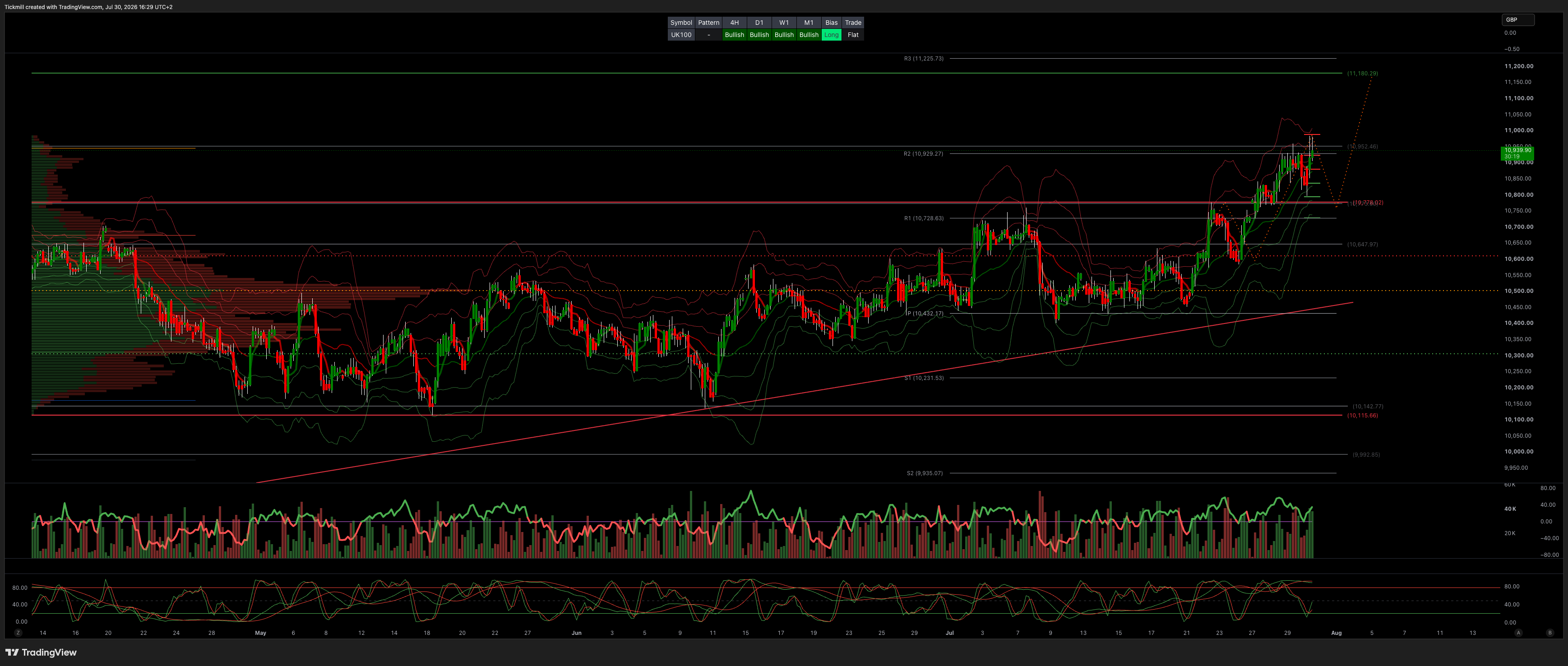
TECHNICAL & TRADE VIEW – FTSE100
Daily VWAP Bullish
Weekly VWAP Bullish
Above 10700 Target 11180
Below 10400 Target 9500
Disclaimer: The material provided is for information purposes only and should not be considered as investment advice. The views, information, or opinions expressed in the text belong solely to the author, and not to the author’s employer, organization, committee or other group or individual or company.
Past performance is not indicative of future results.
High Risk Warning: CFDs are complex instruments and come with a high risk of losing money rapidly due to leverage. 68% and 74% of retail investor accounts lose money when trading CFDs with Tickmill UK Ltd and Tickmill Europe Ltd respectively. You should consider whether you understand how CFDs work and whether you can afford to take the high risk of losing your money.
Futures and Options: Trading futures and options on margin carries a high degree of risk and may result in losses exceeding your initial investment. These products are not suitable for all investors. Ensure you fully understand the risks and take appropriate care to manage your risk.
Patrick has been involved in the financial markets for well over a decade as a self-educated professional trader and money manager. Flitting between the roles of market commentator, analyst and mentor, Patrick has improved the technical skills and psychological stance of literally hundreds of traders – coaching them to become savvy market operators!